Semantic organizational modelling
Defines activities, processes, structure, responsibilities and organizational relationships.
INTEGRATED ORGANIZATION MANAGEMENT MODEL
An integrated organization management model grounded in activities and organizational knowledge.
qConcept connects organizational architecture, everyday business activities, operational information and organizational knowledge in one continuous model of organizational learning and improvement.
Integrated Organization Management Model
ORGANIZATIONAL LEARNING
Every business process, operational activity, customer interaction, employee observation, deviation, problem and improvement initiative creates new experience.
When that experience is connected to business context, responsibilities, rules and organizational goals, it becomes organizational knowledge that can improve future decisions and ways of working.
ORGANIZATIONAL CONTEXT
An operational event becomes meaningful when it can be connected to the business activity where it occurred, the responsible role, applicable rules, documentation, risks and organizational goals.
qConcept first establishes a semantic organizational model - a shared context for understanding information created in everyday work.
WHAT IS qCONCEPT
qConcept combines semantic organizational modelling, organizational sensing, contextual analysis and the continuous creation of organizational knowledge.
Together, they create a unified model for managing the organization, understanding operational reality and gradually developing a digital twin of the organization.
Defines activities, processes, structure, responsibilities and organizational relationships.
Collects information from people, applications, documents and other sources of work.
Connects operational information with the semantic organizational model.
Transforms experiences and events into knowledge that improves future work.
CORE INNOVATION
First, an organizational model describes activities, structure, processes and responsibilities.
Operational information is collected and interpreted in its predefined organizational context.
Experience becomes structured knowledge that supports decisions and improves the model.
qCONCEPT LEARNING CYCLE
THREE KEY COMPONENTS
A methodology for building a complete organizational model.
Discover qMethod →A platform connecting the model, work processes and knowledge.
Discover qPanel →A layer for capturing information from actual organizational work.
Discover qSensor →ORGANIZATIONAL INTELLIGENCE
It is the ability of an organization to understand its own operation, interpret events in business context and continuously improve through accumulated knowledge. Artificial intelligence is one of the technologies that supports this capability.
Semantic model + Operational reality + Organizational knowledge + AI support = Organizational intelligence
DIGITAL TWIN OF THE ORGANIZATION
By continuously connecting the planned organizational model with real activities, events and outcomes, a more accurate digital reflection of the organization emerges.
It is continually enriched with new experiences, knowledge and insights from real work.
Every activity creates experience. Every experience can become knowledge. And every piece of new knowledge can improve the organization.
qConcept
Building Learning Organizations.
Developing Organizational Intelligence.
BASED ON ACTIVITIES. POWERED BY ORGANIZATIONAL INTELLIGENCE
Integrated Organization Management Model
Based on business activities. Powered by organizational intelligence.
qConcept brings together a business activity management methodology, a digital platform and organizational intelligence in a unified model for strategy implementation, organization management and continuous improvement.
Lifecycle of the Integrated Organization Management Model
Activity architecture
qMethod defines the methodology for developing the organizational management architecture, process architecture, responsibilities and management elements.
Discover qMethod →Model digitization
qPanel enables the digital application of the Integrated Organization Management Model and connects its organizational objects.
Discover qPanel →Intelligent organization
qAnalysis AI uses organizational context, operational data and organizational knowledge to support decision-making and continuous improvement.
Discover qAnalysis AI →qMethod defines how the model is built. qPanel enables its application. qAnalysis AI supports its development through organizational intelligence.
Architecture and implementation methodology
Business activity architecture
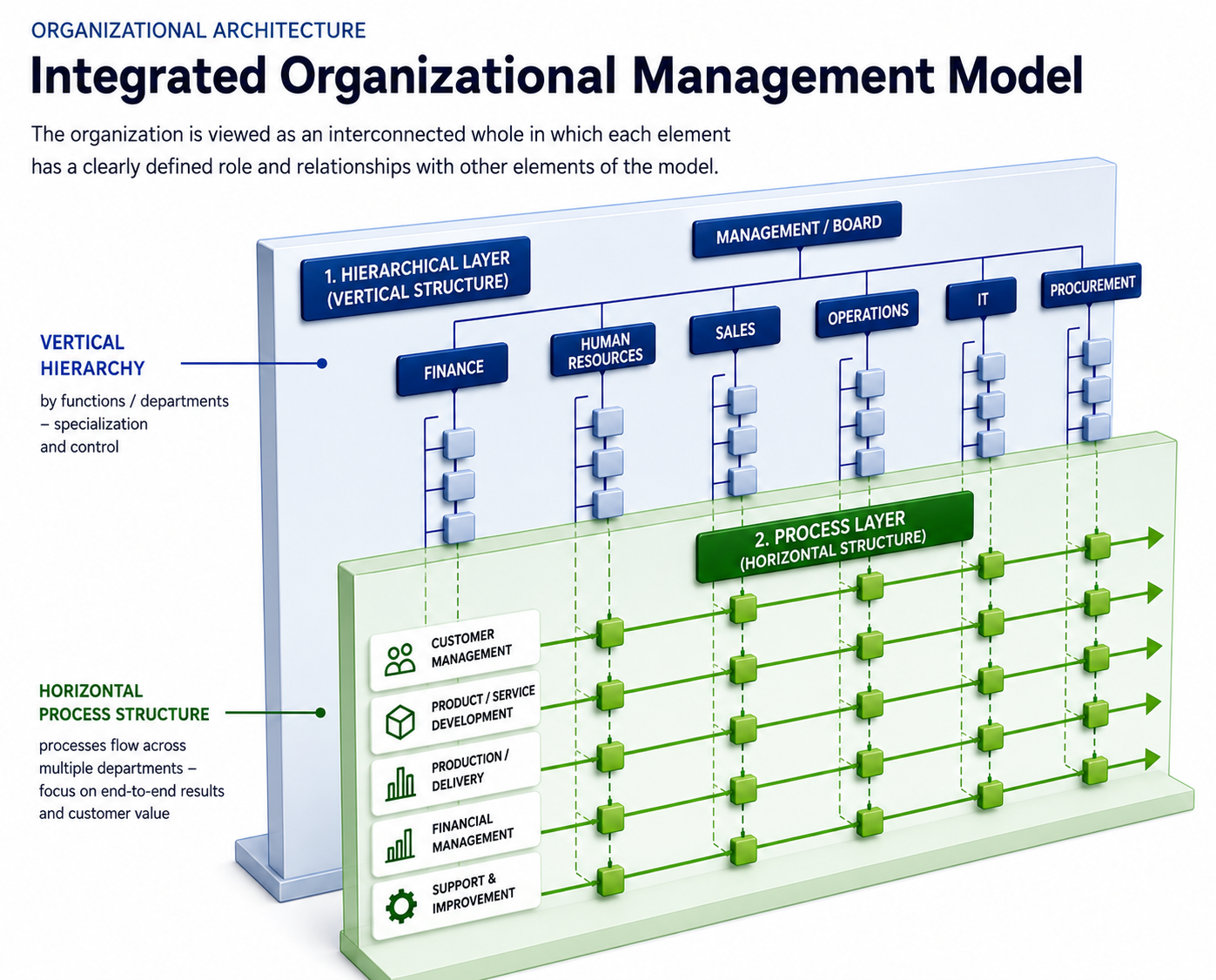
qMethod is a methodology for building the Integrated Organization Management Model through business activity architecture and a change management model.
Before digital implementation, the organization is modeled using the Box in a Box methodology, which enables the hierarchical development of a comprehensive organizational architecture by connecting business activities, processes, organizational structure, responsibilities, information objects and management rules.
Successful implementation of organizational change requires systematically defined business process ownership and clearly assigned responsibility for executing business activities. It is equally important to continuously monitor process results, measure their performance and ensure timely improvement actions.
What makes qMethod different?
Organizational and process architecture are developed simultaneously through a unified business activity model, creating clarity of responsibilities, processes and relationships.
High-Level architecture defines business processes and their relationships, while Low-Level architecture details operational processes, activities, roles and execution rules.
Digital platform
Digital platform for the Integrated Organization Management Model.
qPanel combines the semantic organizational model, business activity digitization and organizational intelligence in a unified online platform for managing the organization.
What makes qPanel different?
Creating a digital semantic model of the organization that understands processes, business activities and their organizational context is the first step. We then collect, interpret and compare operational data with the existing model, enabling organizational intelligence without the need for expensive systems and complex implementations.
Artificial intelligence is not a separate feature; it is embedded throughout the management system. From the AI Assistant and analyses within business modules to automated AI agents, organizational intelligence supports daily work and continuous improvement.
The platform includes
Organizational structure • Processes • Activities • Documentation • Organizational knowledge • Management elements
DMS • Incoming inspection • Supplier evaluation • Internal audit • Workflow • Projects • KPI • AI support
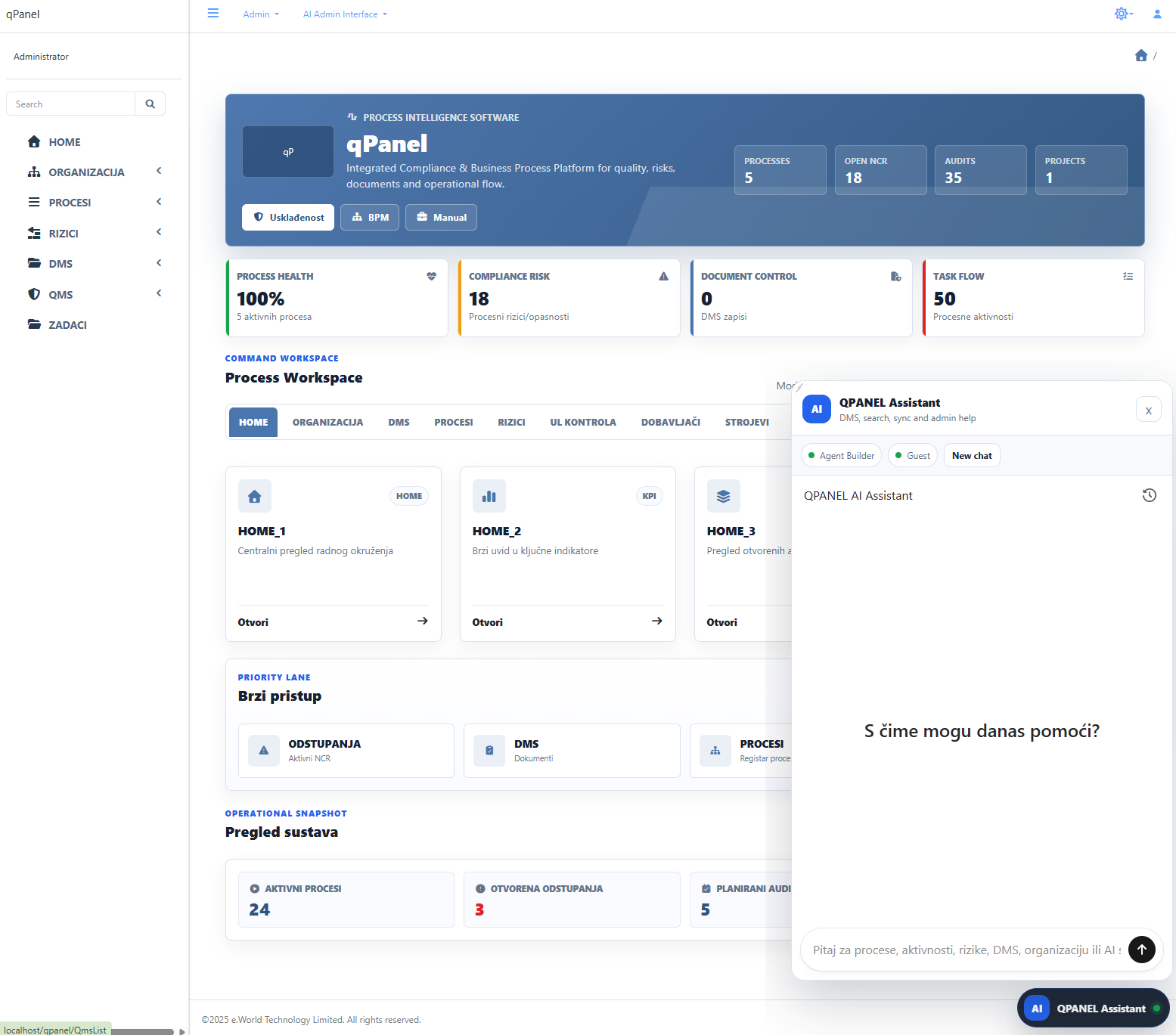
Main functional areas
Structure, units, roles and responsibilities.
Business and operational processes and activities.
Threats, opportunities, assessments and controls.
Documents, records and operating rules.
Compliance, quality and improvements.
Business activity digitization modules use a shared organizational model. They support process automation and the application of organizational intelligence for continuous improvement.
Learn more about the qPanel platformOrganizational intelligence
qAnalysis AI is the organizational intelligence of the Integrated Semantic Organization Management Model, continuously connecting the planned organizational model with real events and business activities.
qSensor collects information from daily organizational work—text, speech, photographs, documents, operational data and other events—and connects it with business activities and the organizational model.
Collected information is interpreted within the organizational context to identify opportunities for improvement, support decision-making and continuously develop the Integrated Organization Management Model.
Organizational intelligence is available at three levels
Natural-language communication and access to organizational knowledge.
Event analysis and decision support within business modules.
Automated monitoring, analysis and execution of predefined organizational activities.
Collects information about real events in the organization.
Connects information with the organizational model and context.
Prepares information, analyses and recommendations to support management decisions.
Turns activity and improvement results into new organizational knowledge.
Intelligence in organizational context
qSensor uses relationships within the Integrated Organization Management Model to connect every data point and event with its actual organizational meaning.
Example of the qSensor feedback loop
Three connected components
qMethod
qMethod defines the methodology for developing the organizational management architecture, process architecture, responsibilities and management elements.
Discover qMethod →qPanel
qPanel enables the digital application of the Integrated Organization Management Model and connects its organizational objects.
Discover qPanel →qAnalysis AI
qAnalysis AI uses organizational context, operational data and organizational knowledge to support decision-making and continuous improvement.
Discover qAnalysis AI →ORGANIZATIONAL MODEL ↓ OPERATIONAL DATA AND EVENTS ↓ ORGANIZATIONAL CONTEXT ↓ RECOMMENDATION AND DECISION ↓ ACTION AND RESULT ↓ NEW ORGANIZATIONAL KNOWLEDGE ↺
qAnalysis AI supports decision-making and model development based on organizational context.